
The Fight for Fair Maps
The Repeal Proposition 4 Initiative
On October 24, 2025, the Utah Republican Party filed an initiative to repeal the Independent Redistricting and Standards Act. If passed, the repeal would eliminate the standards and advisory commission created by Proposition 4 and upheld by Utah courts. These reforms were designed to bring more fairness, transparency, and public accountability to redistricting. Thanks to broad support from Utahns, those standards helped produce the current congressional map, which reflects real communities across the state.
The sponsors had until February 15 to gather around 140,748 signatures statewide, including a minimum of 8% of registered voters’ signatures in at least 26 of Utah’s 29 Senate districts. If successful, the initiative would be on the November 2026 ballot, where Utahns will vote to either repeal or keep Proposition 4.
Utahns Protecting our Constitution (UPOC) along with partner organizations initially responded with a decline-to-sign voter education campaign. As the repeal campaign progressed, reports were made of signature gatherers misleading and/or lying to voters in order to ensure they signed. UPOC pivoted to a statewide signature withdrawal campaign to ensure voters understood both what they had signed and their legal right to remove their names from the petition. UPOC provided simplified paths for these individuals to remove their names from the petition within the 45-day window. Prepaid postage was mailed to those who signed the petition to aid them in this process. On March 9, 2026, the final night of the legislative session, Governor Cox signed an amended HB 242 into law making it illegal to use prepaid postage to submit signature removal requests for initiatives or referendums, effective immediately.
With this change, the signature removal campaign became more focused on specific Senate Districts in order for the signatures to fall below the required threshold in 26 districts. This campaign led to more than 10,600 Utahns submitting requests to remove their names from the petition and 5 districts falling below the minimum threshold.
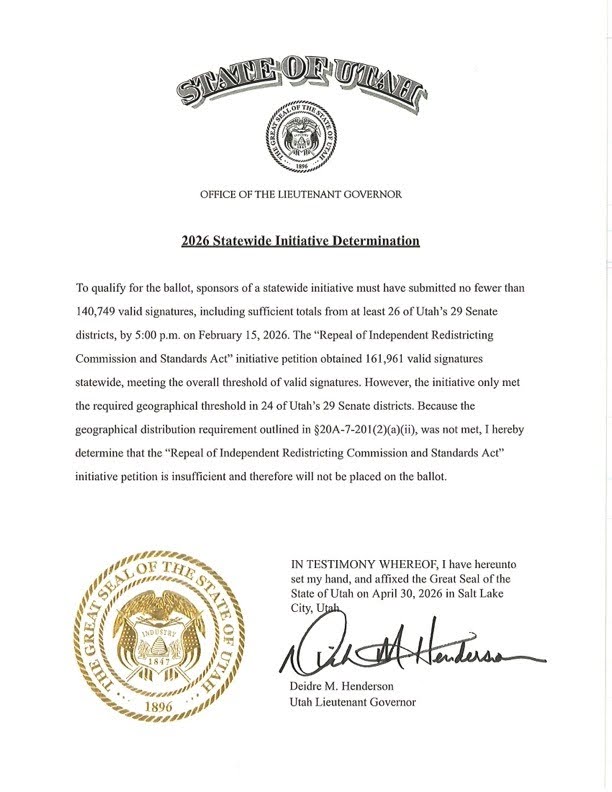
On April 30, 2026, Lieutenant Governor Deidre Henderson officially determined that the Proposition 4 repeal petition was insufficient and would not appear on the November 2026 ballot. Despite facing a repeal campaign backed by more than $4 million, professional signature gatherers, and a significant head start, UPOC and its partners successfully stopped the repeal effort for under $1 million.
August 25th Court Decision
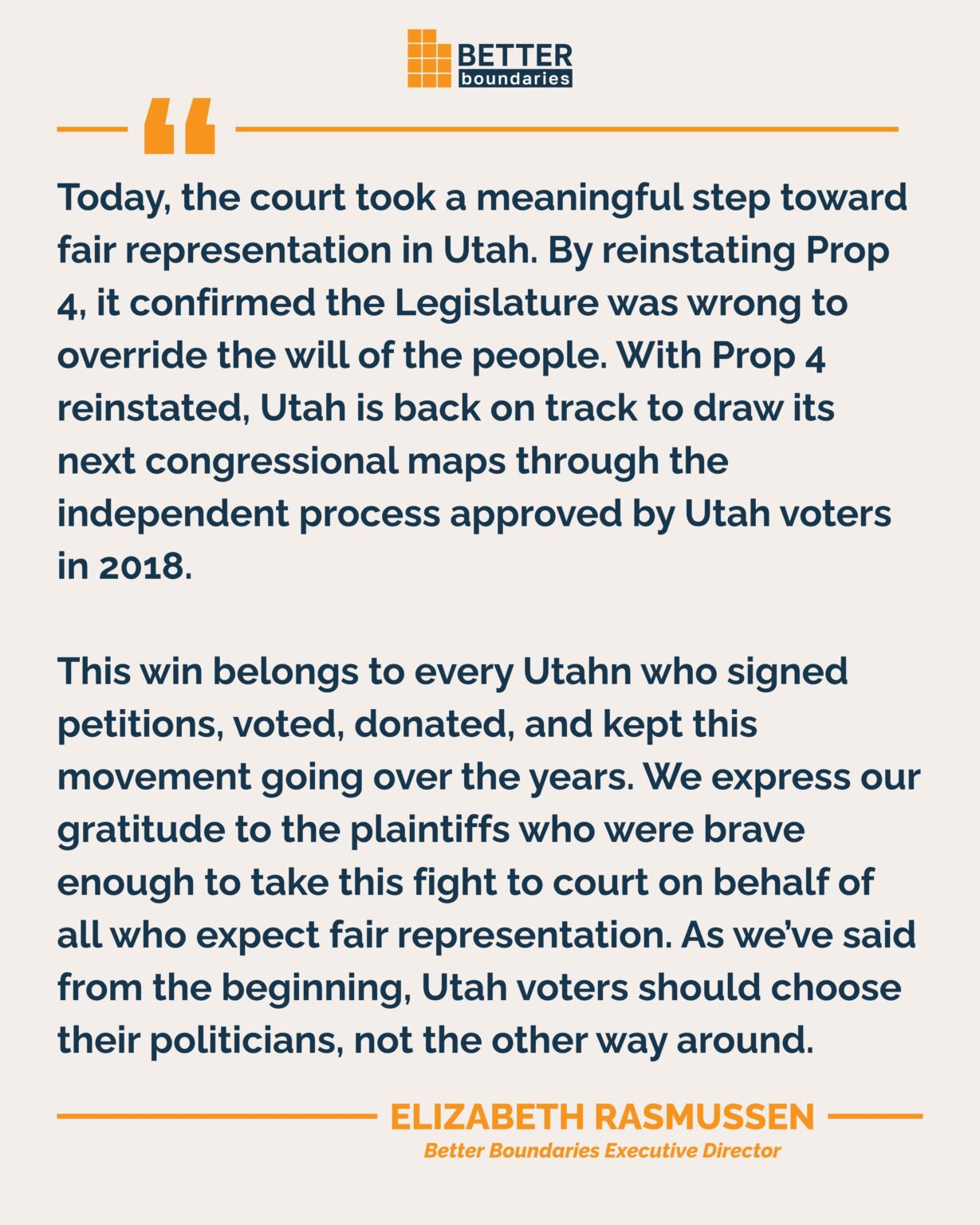
In a major win for Utah’s democracy, the Third District Court ruled that the Legislature’s repeal of Proposition 4 was unconstitutional and reinstated the process and standards voters approved in 2018. As a result, the current congressional maps are no longer valid.
The Court ordered the Legislature to submit new congressional maps that comply with Proposition 4’s process and standards. When the Legislature failed to produce a map that complied with the law, the Court implemented Plaintiff Map 1 for the 2026 elections. This map complies with the standards voters approved, including that the map is:
- Fair: Equal population, no gerrymandering.
- Functional: Districts that make sense geographically and follow natural boundaries.
- Focused: Keep cities and communities together, not divided.
Following this court decision, an effort was initiated to undo the fair process voters put in place when they approved Proposition 4 in 2018, including an initiative to repeal Proposition 4. This effort worked to gather signatures to qualify for the November 2026 ballot.
Legal Strategy
The plaintiffs, along with their expert legal advisors, have a two-pronged legal strategy. The complaint details the facts showing that the legislature’s repeal of Proposition 4 violated the Utah Constitution and that the legislature’s congressional map violates numerous provisions of Utah’s Constitution because it is an extreme partisan gerrymander. It is our hope that the lawsuit reinstates the original language of Prop 4, replaces the gerrymandered congressional map, and safeguards Utahns’ right to reform their government.
First, the complaint argues that the repeal of Prop 4 was unconstitutional. Our government was formed by our consent, for our benefit, and for our protection—all power is inherent in the people. Our state constitution gives us the right to reform our government and sets out a process to do so. That is exactly what we did with Prop 4, and the legislature did not have the authority to repeal the will of the voters. (Utah Const. art. I, § 2).
Second, the complaint argues that the congressional map violates our state Constitution because it is an extreme partisan gerrymander. The Utah Constitution’s Free Elections Clause, for example, states that all elections shall be free and that no power shall interfere with the “free exercise of the right of suffrage.” (Utah Const. art. I, § 17). No matter your ZIP Code, voters should be able to pick their leaders. Politicians should not get to pick which voters to listen to and which to ignore. Extreme partisan gerrymandering on the part of the legislature serves political parties over people, creates distrust in the process, and dilutes our votes — all of which interfere with free elections.
Additionally, the partisan gerrymandered congressional map violates Utahns’ other protected constitutional rights to equal protection under the law, the freedom of association and speech, and the right to vote.
On July 11, 2024, the Utah Supreme Court unanimously delivered a massive victory to the plaintiffs. They ruled that the Utah State Legislature cannot alter citizen-led efforts to reform their government. On August 25th, the Third District Court applied this Utah Supreme Court decision and determined the Utah Legislature violated Utahns’ constitutional rights to alter and reform our government when it repealed Proposition 4. The Court reinstated the law and required a new, compliant map for the 2026 elections.
Litigation Process
March 17, 2022
Plaintiffs file a complaint against the Utah Legislature in the Third District Court.
The Utah Legislature files a motion to dismiss.
May 2, 2022
June 1, 2022
Plaintiffs file a response to the legislature’s motion to dismiss.
The Utah Legislature files a motion to stay based on the US Supreme Court agreeing to review the North Carolina Supreme Court’s decision in Moore v. Harper (2023). Plaintiffs oppose.
July 21, 2022
August 22, 2022
The Third District Court denies the legislature’s first motion to stay.
The Third District Court hears argument on the legislature’s motion to dismiss.
August 24, 2022
October 24, 2022
The Third District Court issues a summary ruling denying the legislature’s motion to dismiss in part, allowing the plaintiffs’ partisan gerrymandering claims to proceed. She dismisses the claim that the repeal of Prop 4 was unconstitutional.
The legislature files an interlocutory appeal asking the Utah Supreme Court to reverse the trial court’s denial of the legislature’s motion to dismiss the plaintiffs’ partisan gerrymandering claims.
November 14, 2022
November 14, 2022
Plaintiffs also file an interlocutory claim arguing that the case should move forward in the district court. However, if the Supreme Court agreed to hear the appeal, they asked the court to reverse the dismissal of the claim asserting that the repeal of Prop 4 was unconstitutional.
The Utah Legislature files a second motion to stay, based on their filing of a petition for interlocutory appeal in the Utah Supreme Court. Plaintiffs oppose.
November 21, 2022
November 22, 2022
The Third District Court issues full decision explaining the Court’s reasoning for the motion to dismiss.
The Third District Court denies the stay request and sets a trial date of May 22–26, 2023.
December 2, 2022
January 6, 2023
The Utah Supreme Court agrees to hear the legislature’s and the plaintiffs’ interlocutory appeals.
The legislature files a third motion to stay based on the Supreme Court granting interlocutory review of defendants’ and plaintiffs’ petitions. Plaintiffs oppose.
January 6, 2023
January 18, 2023
District Court grants motion to stay, pending interlocutory review.
Plaintiffs’ initial brief and legislature’ initial brief are submitted to Utah Supreme Court.
March 31, 2023
April 7, 2023
Amicus Briefs supporting legislature’s positions submitted.
Response briefs due from plaintiffs and legislature.
May 12, 2023
May 19, 2023
Amicus Briefs supporting plaintiffs are submitted.
Plaintiffs and legislature reply briefs are due.
June 16, 2023
July 11, 2023
Supreme Court hearing and interlocutory appeal.
In a unanimous decision, the Utah Supreme Court allows plaintiffs to proceed with their claim that SB 200 violated Utahns’ state constitutional right to alter and reform their government. The Court remands the case to the trial court and orders it to apply strict scrutiny to SB 200.
July 11, 2024
January 31, 2025
Judge Gibson hears arguments from the plaintiffs and the Legislature. During arguments, the Court considers whether the Legislature’s actions violated the people’s constitutional right to reform government, and whether redistricting authority rests exclusively with the legislature.
The Third District Court requests additional information from the plaintiffs and the Legislature on what happens to the legislature-created maps if she rules they did not comply with Prop 4’s criteria.
March 31, 2025
August 25, 2025
Utah’s Third District Court rules the Legislature was wrong to overturn the will of the voters, and reinstated Proposition 4. The Court ordered the Legislature to submit new congressional maps that comply with Proposition 4’s independent redistricting process.
The Utah Legislature convenes a special session to consider six proposed maps and S.B. 1011, which defines the fairness tests used to evaluate maps. After public hearings, the Legislature passes S.B. 1011 and selects Map C to submit to the court.
October 6, 2025
October 6, 2025
Plaintiffs file a third supplemental complaint challenging S.B. 1011. Plaintiffs also submit two maps to the Court, and briefs and expert reports in support of their maps.
The Third District Court hears oral arguments on map submissions and S.B. 1011.
October 23, 2025
November 10, 2025
The Third District Court finds Map C does not comply with Proposition 4’s voter-approved process and fairness standards. It blocks the Legislature’s Map C from being used in the 2026 elections, holds that S.B. 1011 cannot take effect, and orders Plaintiff Map 1 to be used instead.
The Third District Court issues a ruling clarifying boundary issues and denies the Legislature’s request to reconsider or stay her August 25 and November 10 orders, keeping Plaintiff Map 1 in place for 2026.
December 5, 2025
December 7, 2025
The Utah Legislature convenes a special session, passing S.J.R. 201, which gives the Supreme Court original appellate jurisdiction over election cases.
Judge Gibson denied the legislature’s request that she issue a final ruling, while also ruling that the legislature can appeal the case to the Utah Supreme Court.
December 29, 2025
January 8, 2026
The legislature’s lawyers filed a notice to appeal with the Utah Supreme Court signaling that it began its journey in the appellate system.
The plaintiffs filed a motion to the Utah Supreme Court, asking the high court to dismiss the legislature’s appeal based on a lack of jurisdiction. They argued that the legislature had the right to appeal and chose not to, and appealing now would violate the rules of appellate procedure.
January 21, 2026
February 2, 2026
Utah Representatives Celeste Maloy and Burgess Owens and 11 local officials filed a federal lawsuit to try to block Map 1 from taking effect for the 2026 election. They alleged Judge Gibson violated the U.S. Constitution by picking a map submitted by the plaintiffs.
The plaintiffs filed a motion to the Utah Supreme Court to dismiss the legislature’s appeal. They argued that the legislature had the right to appeal and chose not to, and appealing now would violate the rules of appellate procedure.
February 15, 2026
February 20, 2026
The Utah Supreme Court dismissed the legislature’s request to stay Map 1. The court sided with the plaintiffs, stating that the legislature could have appealed the case twice before and didn’t.
The redistricting plaintiffs filed a lawsuit challenging H.B. 392, the law allowing state entities in civil cases to move district court cases to a three-judge panel. They argue it violates the Utah Constitution and unfairly gives the state “super-litigant” status by allowing only government entities to request the panel.
February 22, 2026